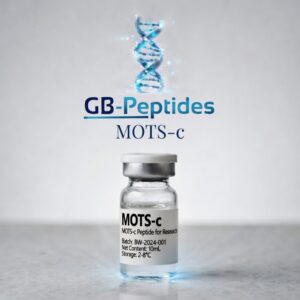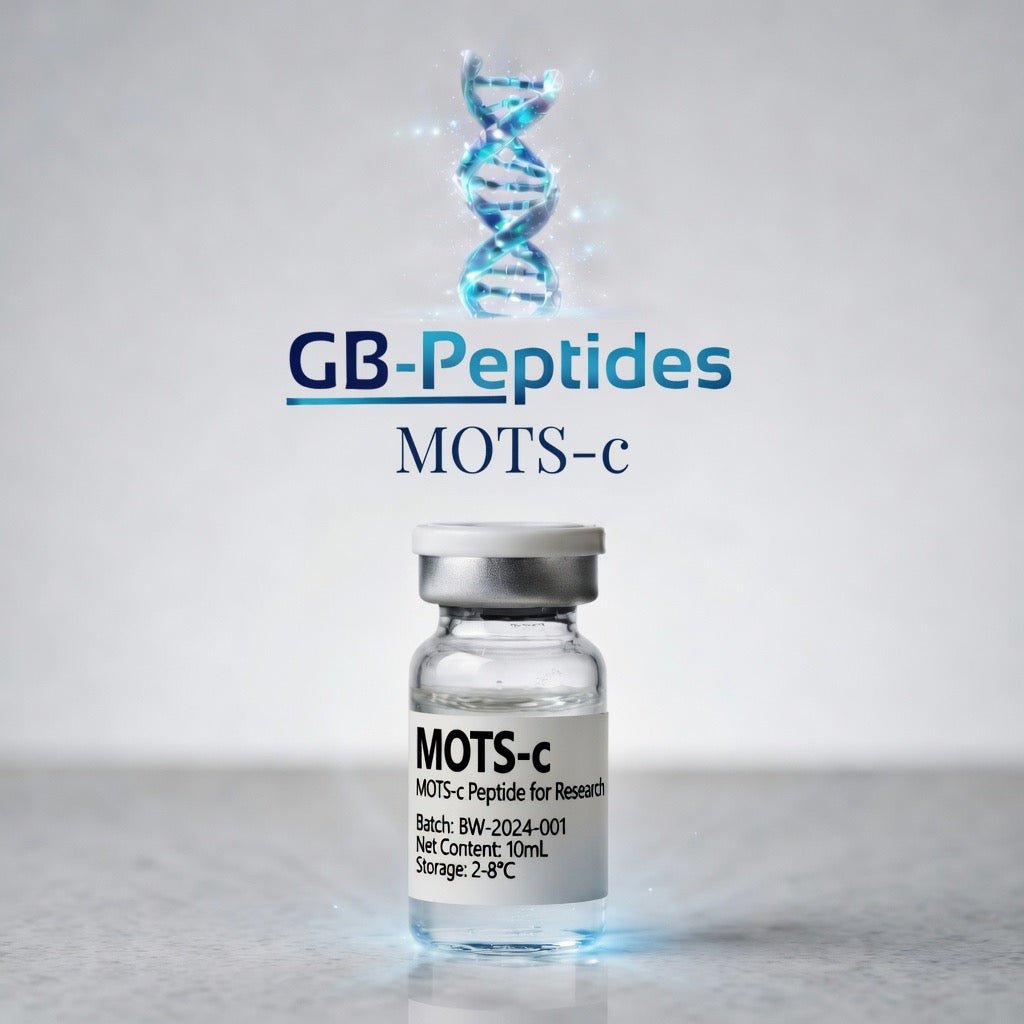
Premium MOTS-c (Mitochondrial-Derived Peptide) UK
Welcome to the highest standard of synthetic peptides. For laboratories and academic researchers looking to buy MOTS-c UK supplies, GB Peptides offers strictly tested, highly purified mitochondrial-derived peptides for advanced in-vitro studies. If you are procuring MOTS-c UK for metabolic, cellular aging, and mitochondrial research, our batch-tested vials provide reliable consistency from sequence to sequence.
MOTS-c (Mitochondrial Open Reading Frame of the 12S rRNA-c) is a unique 16-amino-acid peptide. Unlike most peptides encoded by nuclear DNA, MOTS-c is translated from the mitochondrial genome, functioning as a retrograde signaling molecule that communicates metabolic status from the mitochondria directly to the cellular nucleus.
Mechanism of Action: AMPK Activation and Exercise Mimetics
When evaluating MOTS-c UK in biochemical research models, its role as a metabolic regulator and “exercise mimetic” is essential to understand. MOTS-c primarily acts through the Folate-AICAR-AMPK pathway.
-
AMPK Activation: MOTS-c inhibits the folate cycle and de novo purine biosynthesis, leading to an accumulation of AICAR. This activates 5′-AMP-activated protein kinase (AMPK)—the cellular “master switch” for energy metabolism.
-
Cellular Regulation: By activating AMPK, MOTS-c promotes fatty acid oxidation, enhances glucose uptake in skeletal muscle models, and modulates systemic insulin sensitivity without requiring ATP depletion.
In contemporary clinical research, the administration of this mitochondrial-derived peptide is heavily studied for its ability to mimic the physiological effects of physical exercise on a cellular level, making it a focal point in studies concerning age-related metabolic decline and cellular homeostasis.
For foundational clinical data on how this peptide interacts with metabolic pathways, consult the NCBI review on MOTS-c and Aging. To explore its broader role as an exercise mimetic, review this PubMed publication on MOTS-c and Insulin Sensitivity.
MOTS-c Product Specifications
To ensure accuracy and replicability in your laboratory environments, our MOTS-c UK stock adheres to strict molecular standards. Every batch undergoes rigorous third-party High-Performance Liquid Chromatography (HPLC) and Mass Spectrometry (MS) testing to guarantee $\ge$99% purity.
-
Chemical Name: MOTS-c (Mitochondrial Open Reading Frame of the 12S rRNA-c)
-
Sequence: Met-Arg-Trp-Gln-Glu-Met-Gly-Tyr-Ile-Phe-Tyr-Pro-Arg-Lys-Leu-Arg
-
Molecular Formula: $C_{101}H_{152}N_{28}O_{22}S_2$
-
Molecular Weight: $2174.6\text{ g/mol}$
-
Purity (HPLC): $\ge$99.0%
-
Appearance: White lyophilized solid (freeze-dried powder)
-
Format: 10mg glass vial
Preparation and Storage Guidelines
Proper storage of MOTS-c UK is essential to maintain structural stability. The lyophilized powder is highly stable at room temperature for transit but must be correctly handled upon arrival at your research facility.
-
Storage (Lyophilized): Store unmixed vials in a freezer at -20°C (or below) for long-term stability up to 24 months. Avoid repeated freeze-thaw cycles.
-
Reconstitution: Prior to research applications, the peptide must be reconstituted using sterile bacteriostatic water. Gently roll the vial until fully dissolved; do not shake aggressively, as this can break the delicate peptide bonds.
-
Storage (Reconstituted): Once reconstituted, the solution must be kept refrigerated at 2°C to 8°C and utilized within 30 days to prevent degradation.
Mandatory Research Disclaimer
Please read carefully before purchasing:
This MOTS-c UK product is sold exclusively for strictly controlled in-vitro and laboratory research purposes. This product is not a drug, supplement, food, or cosmetic, and it is absolutely NOT intended for human consumption or diagnostic use.
By purchasing from GB Peptides, you agree that you are a qualified researcher, and this product will be handled in compliance with all relevant UK health and safety regulations. We reserve the right to cancel any order if we suspect the product will be used outside of a sanctioned research environment.